Author Talk: June 29, 2026
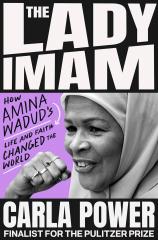
THE LADY IMAM is a timely and soul-stirring biography of one of today’s most influential Islamic female scholars. In this interview, Carla Power explains her decision to write a book about amina wadud, what she hopes readers will take away from it, why she is drawn to study Islam, and the figures who have had the greatest impact on her writing style and worldview.
Question: What first drew you to amina wadud? When did you decide to start writing THE LADY IMAM?
Carla Power: As a journalist, I’ve circled back again and again to writing on Muslim societies, trying to find ways to tell stories about them that don’t feed into the tired stereotypes we so often read in the headlines. If anyone breaks stereotypes, it’s amina wadud. How many single mothers of five have reconceived power relations in a major monotheistic faith? Like millions of others, I’d heard about this daring woman in 2005, when she broke with Islamic tradition by walking to the front of the congregation at Manhattan’s Cathedral of St. John the Divine, giving a sermon, then leading men and women together in prayer.
Then, when I met amina at an Islamic feminist convention in Malaysia in 2009, and saw her charisma, heard a bit about her incredible life, and began to understand what a rock star she was for Muslims looking for justice and equality in their faith, I knew I wanted to write about her. I was fascinated by this theologian who used scripture to challenge the all-too-common assumptions about Islam treating men and women unequally. But I was also drawn to her as an activist, as someone who literally used her body to claim what she sees as God-given rights --- for women as well as men to serve as religious authorities. I was also fascinated by the way her story had a lot to say about being an American, as her quest takes her through poverty and privilege, various subcultures and academia, revealing much about everything from race to motherhood along the way.
As a feminist and an American, I was angry that such a fascinating figure wasn’t known much outside of Islamic Studies circles. I was busy with other books, but I finally approached amina about writing her biography in the summer of 2019. I had to finish HOME, LAND, SECURITY (2021) before rolling up my sleeves to work on amina’s story. But it was great when I could finally focus on it!
Q: wadud consistently refers to Toni Morrison as a source of inspiration in her life. Are there any figures in your life who hold a similar place in your heart or have influenced your writing style and worldview?
CP: My mom was an academic who taught Gender Studies, and so I grew up in a household that seemed to have a copy of Virginia Woolf’s A ROOM OF ONE’S OWN in every room. Even now, I find myself dipping into this meditation on how the patriarchy shaped British society, and I find new ways it’s relevant to my own life every time.
Like so many others, I’m heavily influenced by the cultural critic Edward Said’s writings on how Western cultures have constructed non-Western cultures. Reading his ORIENTALISM as an undergraduate changed how I saw the world and how I thought about the Muslim cultures I’d spent so much time in as a child. It was his work that inspired me to go on to study and write about Islamic societies, and to be super mindful of the language and framing I used.
This is slightly left-field for a nonfiction writer, but the artist who taught me to love language, cadence and economy in writing was Stephen Sondheim, the musical theater genius. I grew up listening to his shows and poring over the liner notes (and yeah, miming the songs in my bedroom!). They taught me lots about love, loss, art and wit.
Q: This is not your first book on Islam or the Qur’an. Did writing this book challenge your own perspective on Islam and its central tenets in any way?
CP: Yes! I think the most powerful reorganization of my understanding comes through amina’s Tawhidic Paradigm. It basically says that if God is everywhere, and one, and unifying, and is the only entity that should be above anyone else, then any person who claims power over another person (a man over a woman, a white person over a person of color, etc.) is putting themselves in a God-like position and is thus committing a terrible sin in Islam. It was so exciting to see how amina applied a Qur’anic concept to human rights issues.
Q: What do you hope that readers take away from THE LADY IMAM?
CP: Too often, Islam is represented in the headlines as a brittle faith. Non-Muslims often miss the diverse possibilities that lie in its traditions and the interpretive variety that its scholars can draw on. For non-Muslims, I hope amina’s story gives a taste of these riches.
I hope I can persuade people that amina wadud’s name deserves to be as well known as Malcolm X’s, as an American Muslim who changed the lives of countless people, and who inspired people around the world. Whether you agree or disagree with her interpretations, she stands as an important American intellectual and Muslim thinker-activist-icon, someone whose work is central to one of the great global civil rights struggles of our times: justice and equality for all Muslims. I hope her story will resonate with people on a personal level, as a story of hardship, persistence and courage. Right now, as we’re debating what it means to be an American and what being a Muslim means, her story shows that there are all sorts of ways to be both of these identities.
Q: You have spoken about growing up in a Jewish and Quaker household that was in many ways secular. What draws you to study Islam?
CP: I grew up with very little religious education. My parents had both pretty much abandoned their faith traditions as anything more than cultural traditions. If they had a religion, it was a passion about understanding other cultures. They regularly took us from our base in St. Louis, Missouri, to live abroad in Iran, India, Afghanistan and Egypt and to travel widely every summer. A childhood spent toggling between the Midwest and the Middle East and Asia made me interested in how Islam is practiced in different places.
I’m also really drawn to understanding people with worldviews very different from my own --- and to finding common ground with them. So it was that my first book, IF THE OCEANS WERE INK, was about my friendship with a conservative Muslim scholar, whose life and religious observance couldn’t have been more different from my own. Tracing where our worldviews converged and diverged was one of the most profound experiences of my life.
It also made me interested in the history of Islamic women scholars, because the subject of the book, Sheikh Mohammad Akram Nadwi, had discovered an all-but-ignored history of thousands of women scholars, stretching back to the seventh century. I used to call him “the accidental feminist,” since he certainly wouldn’t consider himself a feminist. Yet he uncovered women who were experts in the Qur’an and other Islamic studies, who were judges, roving scholars on camel-back, consulted as experts by caliphs and kings. A whole forgotten history of female scholars!
My second book, HOME, LAND, SECURITY, wasn’t about Islam, but rather about how the politicization of Islamic (or far-right) ideologies can lead to terrorism. Like IF THE OCEANS WERE INK, it was about the challenge of trying to find common ground, or at least understanding, with people whose views are different from my own. A study of how people are drawn into violent extremist groups --- either jihadi or white supremacist --- it looked at how various deradicalization programs around the world try to reform their thinking and behavior. Talking to former recruits to ISIS, the Taliban and neo-Nazi groups was an exercise in trying to find humanity in those who many people would write off as evil.