Author Talk: September 30, 2026
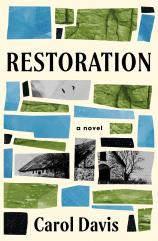
RESTORATION is an evocative work of fiction about an American architect who travels to rural England to restore a centuries-old barn --- and finds herself rebuilding the fractured story of her own family. In this interview, Carol Davis talks about her inspiration for her debut novel and the research she conducted for it; how her attitude towards complex relationships, as well as her understanding of grief and love, evolved throughout the writing process; and what she hopes readers will take away from the book.
Question: What was your inspiration for writing RESTORATION? When did you decide to start writing the book, and are any of the characters influenced by people in your life?
Carol Davis: It actually started with a short story I wrote years ago, about a mother and daughter with a difficult relationship. Looking back, I think the characters came across as too strident --- the daughter especially --- so I put the story in a drawer and moved on. But they wouldn’t leave me alone. I kept thinking about them, I’d even dream about them, and eventually I just had to sit down and start writing. That became the first draft of the novel. Once I was in it, new plot lines kept surfacing and new characters kept arriving. Before I knew it, I had a 485-page manuscript on my hands. I’ve rewritten it at least four times since.
As for the characters, a few are composites of people I know, but most of them are people I simply made up to serve the story.
Q: You hold a BA in Art and Architectural History, and an MFA in Writing and Literature. Your work as a researcher, archivist, teacher and writer has taken you into close collaboration with architects and art conservators around the world. How have these experiences shaped the way you view architecture and art, and what first inspired you to connect physical restoration with emotional and psychological healing?
CD: There’s a lot packed into this question. I might need to write another short story just to answer it fully!
I originally wanted to be an architect, so my undergraduate studies were really meant to prepare me for that career. I took studio classes --- drawing, printmaking, even a ceramics class, though I was never much good at the wheel --- and started building a portfolio for architecture school. My university also had a small but wonderful museum on campus, where I volunteered for a couple of years. I learned so much there about the work of a curator: how exhibits are installed, how acquisitions are made. They even let me try my hand at writing a review for one of the shows. I felt completely at home in the arts, and I set my sights on finding work in the field after graduation.
Shortly after graduation, I moved to London and worked as a personal assistant to an architect. It was my first real taste of a large, busy office, where I got to observe the interpersonal dynamics between the principals and the associates up close. This was before the internet, before CAD, and I loved watching a schematic drawing evolve into an exacting scale drawing, all done by hand with a mechanical pencil, a straight-edge and a compass. To me, those drawings were works of art.
My dear friend is an art conservator who specializes in architectural conservation, and her work has always inspired me. I’ve learned a great deal from her about materials and the processes of repair.
I’m not a trained artist or architect, but I do have a good instinct for how space ought to flow, how to draw natural light into a room, and for color. I can walk into an old house or apartment and know almost immediately what it needs --- always mindful of its origins. Two books I read as an undergraduate shaped the way I see buildings and experience space: THE POETICS OF SPACE by Gaston Bachelard and THE TIMELESS WAY OF BUILDING by Christopher Alexander. Bachelard writes about how each room in a house imprints itself on our psyche in deeply instinctual ways, and Alexander explores how thoughtful, well-built spaces let our inner lives unfold. Often these experiences are subliminal rather than intellectual --- not the kind of thing you can easily put into words.
So I didn’t set out to write a book about spiritual restoration. It happened organically, as my main character began to face challenges she never thought possible. Each fracture she encountered in her own life seemed to mirror the fractures in the history of the barn and the landscape around it.
Q: What type of research was involved in writing RESTORATION? What did you find the most challenging? What did you find that was the most interesting?
CD: My background in architectural history shaped the novel from the very beginning. Long
before I knew exactly who Risa was, I knew she would be an architect who specialized in restoration. RESTORATION is about far more than preserving old buildings. It asks what we value, what we choose to save, and how we carry the past into the present without erasing its history. Those questions became the emotional architecture of the novel as well.
Once I knew Risa would be traveling to rural Wiltshire to restore a barn, I immersed myself in researching the traditional farm buildings of that region. I wanted the setting to feel completely authentic --- not just visually, but materially and historically. I read everything I could find on vernacular architecture, timber framing and traditional building techniques, but eventually I realized books could only take me so far.
A few years ago, my husband and I spent six weeks living in a restored barn in a small village near Tisbury. It had been beautifully renovated by a mother and daughter, and it became the perfect place to imagine life in a close-knit rural community. We spent our days walking ancient footpaths, visiting churches, graveyards, stone circles and prehistoric monuments, and our evenings in local pubs where people generously shared stories about their lives.
By some marvelous coincidence, one of the barns that had fascinated me in my research was in Tisbury itself: it was one of the largest surviving tithe barns in Britain, recently restored as an arts and community center. I spent hours studying its proportions, materials and construction, trying to understand not only how it had been built, but how it had endured. That experience deeply informed the restoration scenes in the novel.
Architecture also shaped the way I imagined Risa. She is an architect who approaches the world with a discerning eye --- someone trained to observe carefully, respect what has come before, and repair rather than replace. At the beginning of the novel, she is far better at restoring buildings than understanding herself. Her journey is to discover that people, unlike buildings, cannot be restored by technical expertise alone. They require vulnerability, memory and love.
Q: The novel opens in San Francisco before moving into the English countryside. What drew you to England as the setting for the central restoration project, and what did that landscape allow you to explore that another setting might not have?
CD: The original short story that eventually became RESTORATION took place entirely inside the mother's apartment in San Francisco. The daughter lived nearby. I chose San Francisco almost instinctively because it has always felt like a moody city to me. By that I mean the landscape and weather can create a profound sense of uncertainty and dislocation.
The city's steep hills are beautiful, but they can also feel precarious. Driving uphill, especially in fog or rain, there are moments when you can't see what's beyond the crest. You simply have to keep going and trust that the road continues. Driving downhill brings a different kind of vulnerability, and even walking the city requires that you pay close attention to where you’re going. I didn't realize it at the time, but San Francisco's terrain became an emotional reference for the relationship between mother and daughter. The weather and landscape carried the instability and unpredictability of their lives.
Risa came to Wiltshire because I had spent time in a restored barn there belonging to an acquaintance. I fell in love with the stone walls, rough-hewn beams, steeply pitched ceilings and thatched roof. The house sat quietly in a valley surrounded by rolling green hills, and something about it lodged deep in my imagination. I'm reminded of Gaston Bachelard's observation in THE POETICS OF SPACE: “...it is because our memories of former dwelling places are relived as daydreams that these dwelling places of the past remain in us for all time.” Although I never lived in that house, the place never really left me.
Only in later drafts did I recognize how much San Francisco and Wiltshire had in common. Both are landscapes that ask you to pay attention. The weather changes quickly. Navigating the terrain can be tricky; the twisty, narrow two-lane roads in Wiltshire, bordered by high hedges on either side, or high stone walls, can feel precarious. Neither place allows you to move through it without paying attention. Those qualities became essential to Risa's journey. As she gradually learns to read the landscape rather than master it, she also begins to relinquish the illusion of control that has shaped her life. In that way, both landscapes function as teachers.
Q: Many readers will be fascinated by the dream sequences and mystical elements surrounding the barn, the henge and the landscape. How did you approach balancing psychological realism with these more spiritual or symbolic moments?
CD: These scenes were a joy to write. Many of the dream sequences grew out of a series of freewriting exercises I devised for myself, using prompts like paintings, drawings and prints. I leaned on Blake’s poems and images for quite a few of them.
The setting drew on real experience, too. My husband and I spent about six weeks living in a restored barn in a small village near Tisbury, England. We’d spend our days walking the footpaths and tracks, visiting old graveyards, stone circles and monuments, and the local people shared the most marvelous stories about their lives in their village and beyond. All of it --- the landscape, the stories, the sense of the place --- fed into Risa’s interior narrative, which ultimately guides the novel and runs parallel to her inner and outer worlds. She begins as a skeptic, but as she encounters things she can’t explain, she gradually opens to the possibility that some things simply can’t be articulated.
For me, the key was always to anchor those mystical moments in Risa’s psychology. Whatever she encountered --- a dream, a strange feeling in the barn, a sense that the landscape was speaking to her --- had to feel true to where she was emotionally at that point in the story. As long as it grew out of her inner life, I trusted the reader would follow her into the more mysterious territory without ever feeling they’d left the real world behind.
Q: Your story explores many complex relationships, especially familial ones. How did your attitude towards such relationships --- and your understanding of grief and love --- evolve while writing the book?
CD: The relationship between Risa and Helen was a complicated one. When I first started, I wrote Helen and Risa with no nuance at all. Helen was someone Risa simply wouldn’t let into her life. She was annoying, cloying, with no redeeming qualities whatsoever. But no one is only ever one-dimensional, and so I allowed Risa to soften, to allow for moments when she felt the connection between them could be palpable. Eventually, Risa delves into Helen’s past, their shared past, and begins to see her through a different lens. It was then that Helen grew into a far more multidimensional character, as did Risa. As Risa’s understanding of her mother’s life deepened, so did her compassion --- and so, I have to say, did mine.
Writing the book showed me that love and grief are two sides of the same coin. We grieve in proportion to the intensity of our love for another, even if we don’t understand it. Grief is almost a measure of that love --- it’s a feeling, really, turned inside out by loss. Risa spends so much of the story resisting her grief, and what she slowly comes to understand is that letting herself feel it is also a way of letting herself love. I don’t think I fully understood that when I began writing the story. I learned it along with the characters as I wrote.
You see it too in Risa’s relationship with Hiro, her partner of many years. The hardest things they went through together were the very things that bound them most deeply, though Risa couldn’t see that at the time. They were grieving the same loss, side by side, and yet the grief drove a wedge between them rather than drawing them close. It wasn’t until they were separated that she understood how much she loved him, and how much of that love had been forged in their years together and what they’d suffered together.
Q: If there is one idea or question you hope readers continue thinking about after finishing RESTORATION, what would it be?
CD: My hope is that readers come away with a sense of curiosity and generosity toward the people in their lives --- and maybe extend it to those they don't know as well. So much of what we think we know about another person is really only part of their story; the picture we carry is often a little one-dimensional. Risa's myopic view of Helen --- and ultimately of herself --- created a very narrow world for them both. There was little chance of the two of them opening to each other, of entering into any real relationship, until Risa came to understand what had actually happened. It wasn't until she could truly hear her mother's story that things began to shift. I often wonder how differently they might have spoken to each other had that happened sooner.
As human beings, I think we could all stand to get a little better at listening. That, to me, is its own kind of restoration --- the slow, patient work of repairing what’s grown distant between us, one story at a time.