Author Talk: May 13, 2026
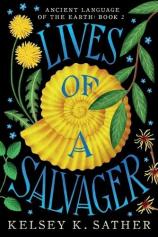
LIVES OF A SALVAGER is Kelsey K. Sather’s second Ancient Language of the Earth book, a stand-alone novel in her multigenerational fantasy series about plant magic, memory, and the cost of saving a dying planet. In this interview, Sather discusses her approach to building a world as deep and complex as Aligaea; how her writing process differed from that of the first book in the series, BIRTH OF THE ANIMA; and the impact that her love of nature has had on the creation of these sweeping tales.
Question: The world of Aligaea is rich in lore. You have created several maps to illustrate the world and even have multiple pages dedicated to key terminology, timelines and characters at the end of the book. How do you typically approach building a world as deep and complex as this?
Kelsey K. Sather: It’s an organic process that began over a decade ago. I alternate between phases when I’m writing scenes and chapters for my next book in the series, and when I work on detailing the world’s biomes, cultures, magic system and history. The story shapes Aligaea, and vice versa. I spent a few months in 2024 compiling all the world details from BIRTH OF THE ANIMA with all the world details from LIVES OF A SALVAGER into a 220-page document titled “Life on Aligaea,” ensuring both grand historic events and place minutiae aligned. This process was as tedious as it sounds, but essential for creating verisimilitude and cohesion.
Q: LIVES OF A SALVAGER is the second book in the Ancient Language of the Earth series. What did the writing process look like, and how was it different from writing your first book?
KKS: Sometimes people imagine the act of writing to be this mysterious and alluring process, when in reality it’s quite simple and repetitive: open document on computer, type, save, repeat. Day after day, month after month, until those 500-word sessions accumulate into a 150,000-word document. Then it’s edits --- endless edits!
That being said, the emotional tenor while writing LIVES OF A SALVAGER was quite different from that of BIRTH OF THE ANIMA. It was a test of resilience and dedication, writing a second novel. It took time to fall back in love with creating for the sake of creating after focusing on the external process of launching a book into the world. Sometimes we have to show up before we’re motivated, but once we do, the magic can begin.
While the physical act of writing isn’t mysterious and alluring, the ways characters may surprise you, or a wild plot twist you didn’t see coming, is the mystery and allure of creating fiction. It’s those moments of surprise that make the monotony of writing worth it to me, alongside entering flow state on occasion, where time disappears as the story pours onto the page.
Q: Did any specific authors, books or real-life events inspire you to write LIVES OF A SALVAGER? What influences your writing?
KKS: My wandering studies in spirituality probably had the largest subconscious influence on LIVES OF A SALVAGER, especially in relation to how we navigate ecological and societal dilemmas. I read a lot of nonfiction, and while writing LIVES OF A SALVAGER, I read ENTANGLED LIFE by Merlin Sheldrake, BRAIDING SWEETGRASS by Robin Wall Kimmerer, THE SPELL OF THE SENSUOUS by David Abram, and FINDING THE MOTHER TREE by Suzanne Simard. These personal narratives informed by ecology and biology offered innumerable nuggets of intellectual interest and metaphoric potential that found their ways into the story --- for example, Laurel’s teachings in the “Beech Bread” chapter.
The witch market in the “Moonflower” chapter was informed by a trip I took to el Mercado de Brujas in Peru 20 years ago. Other travels and time spent in wild places offer plenty of details to weave throughout my work, from the way a boreal forest smells after rain to how an ancient horsehair lyre sounds. The main thing that inspires my work is our amazing world, with its rich cultural and ecological diversity.
Q: You have often discussed your love of nature. How has a life spent outdoors impacted the writing of LIVES OF A SALVAGER and the series as a whole?
KKS: I’m no expert, but if anyone were to ask me what the best thing we can do for the environment is, I’d say it’s cultivating a relationship with nature. It’s hard to care about what’s happening to other species when we don’t know them. I love moving in ecosystems as a way to better understand them, whether that’s climbing sandstone in the desert or walking as quietly as possible through the montane while bow-hunting.
The series as a whole, and my intentions behind it, were born from my love for the natural world and the wondrous plants and animals we cohabitate with in our various ecosystems. In a time of mass extinction and environmental degradation, LIVES OF A SALVAGER is an emotional processing of what it means to be alive as a human animal today.
Q: You have mentioned before that LIVES OF A SALVAGER addresses urgent questions, such as “To what end must we preserve environmental integrity, and is it emotionally sustainable?” Have you come any closer to an answer in writing this book? Were there other questions that writing this book answered for you?
KKS: This book finds us thick in the plot, where hope and resiliency are but flickering embers following the Clash of Mages and Thorns. In our world, it can be hard to have faith in humanity and our ability to rise to the ecological and societal challenges facing us when the heartbreaking headlines are endless. The Void in the book is a place many of us have probably visited, where we stick our heads in the sand and live out our days as Khen, merely surviving.
I don’t have any answers. This book is more of an exploration of the emotional spectrum we find ourselves on when we explore those urgent questions. It also works with the first book, BIRTH OF THE ANIMA, to provide millennia of context for what the final Anima steps into when she transforms. For while she is largely ignorant of the expansive history leading to her transformation --- and the pivotal time she is born within, for Keepers and Commoners alike --- we, the readers, know and can appreciate the magnitude of her choices.
LIVES OF A SALVAGER answered many questions about the world and the series’ plot posed in the first book, but the series’ ending remains unwritten. Same with our world. We are the authors of our shared story. None of us live in a vacuum, and our children inherit whatever choices we make today. Since becoming a mother, this truth feels more motivating than ever, but also more daunting. In my experience, emotional sustainability is a function of love: love for our family and friends, love for others, love for nature --- love for the world, in all its complexity.
Q: Do you see Aligaea as similar to the world we all live in?
KKS: Absolutely. That’s the point. It’s a funhouse mirror. I call Aligaea an earth species. You and I are both of the human species, with essentially the same biological composition, and yet our stories are vastly different (though we probably have some things in common, too). Aligaea asks us to both celebrate our world and question our words and actions. It asks us to be awake in this one precious life on this one precious planet. The big difference between Earth and Aligaea is the presence and influence of magic --- or is it? ;)