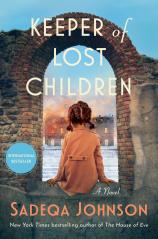
Keeper of Lost Children
Review
Keeper of Lost Children
I'm a huge fan of Sadeqa Johnson, and KEEPER OF LOST CHILDREN is as emotionally riveting and filled with fascinating --- and often horrifying --- historical details as her earlier novel, YELLOW WIFE.
The three main characters are very different individuals. Ethel Gathers is a married Black woman living in postwar Germany in 1950 with her husband, who is in the military. Ozzie Phillips is a Black teenager who volunteers in the Army at the age of 19. He is heading to Germany in 1948 and optimistically hoping to be able to use his intellect in Army Intelligence. And then there's 16-year-old Sophia Clark, who finds out that she was selected to receive a scholarship to integrate a posh private high school. But she's worried that her parents won't let her go because they need her help on the farm. Her story begins in 1965.
At first, it's difficult to understand why the timelines are so different. But the characters and their situations are compelling, and we quickly feel Ethel's pain at not being able to conceive the child she so desperately longs for. We empathize with Ozzie's frustration when, because of his skin color, he's sidelined and forced to do menial labor, even though his score on the Army aptitude test was perfect and the Army was recently desegregated --- at least on paper. Men with far less intellect are his superiors, and that grates.
"The concepts, the issues that the characters must face, and the resolution of the story are all beautifully conceived and executed. I cried several times because of Johnson's moving narrative and emotional finale."
But it's Sophia, with her horrible living situation, who really engenders our sympathy. Her parents are uncaring and only interact with their four children when they are directing them to do farm work. The kids call them Ma Deary and the Old Man, not even Mom and Dad. There is no affection, no words of praise, nothing at all to indicate that they care for the children. Sophia has an older brother, Walter, and twin younger brothers. They plant the vegetables, care for the livestock, gather the eggs and clean the barn. Some of the treatment that we read about is truly shocking.
So when Sophia has a chance to attend a private boarding school, she tells Walter she wants to go. She's rightly worried that Ma Deary won't allow it because she'd lose a farmhand. She knows that her mother certainly wouldn't drive her, so Walter takes her. At the school, Sophia often feels like she doesn't belong. She has few clothes, unlike her roommate, who is the only other Black girl in their grade. Willa's parents are educated, her father is a doctor, and she is obviously pampered. In spite of their differences, they become best friends.
Sophia's brains and physical abilities, honed from working in the fields and playing ball with her brothers, make her an asset to the girls basketball team. She does well academically but deeply feels the prejudice that surrounds her, not only from several students, but also from many teachers. And some of her teammates are horribly cruel in their treatment of her. It's when a fellow student makes her question her identity and background that her pluck and determination cause her to start a journey that is the heart of the novel.
Because of Johnson's exhaustive research, she weaves in real history as she fictionalizes historical figures. Ethel is based on Mabel T. Grammer, who was an advocate of adoption and a civil rights activist. Like Ethel, she was a journalist and a devout Catholic. When she lived in Mannheim, Germany, she met desperate German mothers who, during relationships with African American troops, bore mixed-race babies. Those children were not accepted into German society, and their mothers were ostracized. Those fathers who wanted to marry their white German lovers were not allowed to do so by the military. Grammer decided to try to get the children who were in orphanages adopted by Black families in Germany and America. She and her husband adopted 12 children. In the novel, Ethel and her husband adopt "only" eight.
Woven in with the fictional narratives are real examples of the horrors of Jim Crow and the cruelties of prejudice. Rita mentions an uncle, based on an actual historical figure, who was murdered for trying to vote in Georgia. Another young man was killed for using a gas station bathroom in the south. One military nurse mentions a relative who was shot and crawled miles to a hospital, only to be turned away because they would only treat white people. In fact, she laments that while she is a trained nurse, she's only allowed to work with patients who share her skin color.
What Johnson also shows, perhaps because of her devout religious beliefs, is the concept of forgiveness. There are many examples of the characters in the novel forgiving those who made mistakes, who were cruel, and who disappointed. One of the paradoxes is that in Germany, the African American troops felt more at home and less the victims of bigotry. But Ozzie comments, "Even though Germany appeared to be more color-blind, I guess the truth was a lot more complicated."
The concepts, the issues that the characters must face, and the resolution of the story are all beautifully conceived and executed. I cried several times because of Johnson's moving narrative and emotional finale. Books like this are extremely important right now, perhaps more so than ever. When we read about people of color and women being forced to resign from positions of power in the military, it echoes the prejudices of the past. KEEPER OF LOST CHILDREN is set 80 years ago, and it's heartbreaking to think that we have advanced so little in terms of change.
Reviewed by Pamela Kramer on February 13, 2026
Keeper of Lost Children
- Publication Date: February 10, 2026
- Genres: Fiction, Historical Fiction, Women's Fiction
- Hardcover: 464 pages
- Publisher: 37 Ink
- ISBN-10: 1668069911
- ISBN-13: 9781668069912